After model access, who can use experimental feedback? The platform boundary of Lilly TuneLab
As TuneLab connects laboratory services and scientific data tools, can model access become sustained learning? The conditions are comparable experiments, usage permissions, and incremental decision value—not partner lists or call counts.
Once drug-discovery models become available to more companies, what should a platform seek next? One intuition is more calls and users, eventually producing software-subscription revenue. Lilly TuneLab's recent connections with experimental-service providers and scientific data systems suggest another path: models help members select experiments; results that pass quality and usage-permission checks contribute to learning; a later model version may then help more members make better choices.
My view is that part of an AI drug-discovery platform's advantage will come from a sustained ability to obtain, interpret, and legitimately learn from experimental feedback, rather than from model access alone. A new partner does not automatically create that advantage. Comparable experiments, retained negative results, permitted uses, and improvements on independent projects determine whether the cycle works. The analysis below uses disclosures verifiable as of October 7, 2026, without treating ecosystem expansion as demonstrated drug-development returns.
1. What is exchanged: model access and usable training feedback
When Lilly launched TuneLab on September 9, 2025, it already described selected biotech partners contributing training data in return for access. “Opening” access does not mean releasing all training data or model weights as open source. The company's description of historical data-acquisition costs is also not a platform valuation or sales figure.
The newer development is closer to the experimental end. GenScript's September 16, 2026 announcement states that it will offer preferred-rate wet-lab services to TuneLab members, expressing, purifying, and characterizing prioritized sequences through standardized, fully documented protocols. This establishes an announced service agreement. It does not disclose completed order volumes, contract revenue, or R&D gains relative to a control workflow.
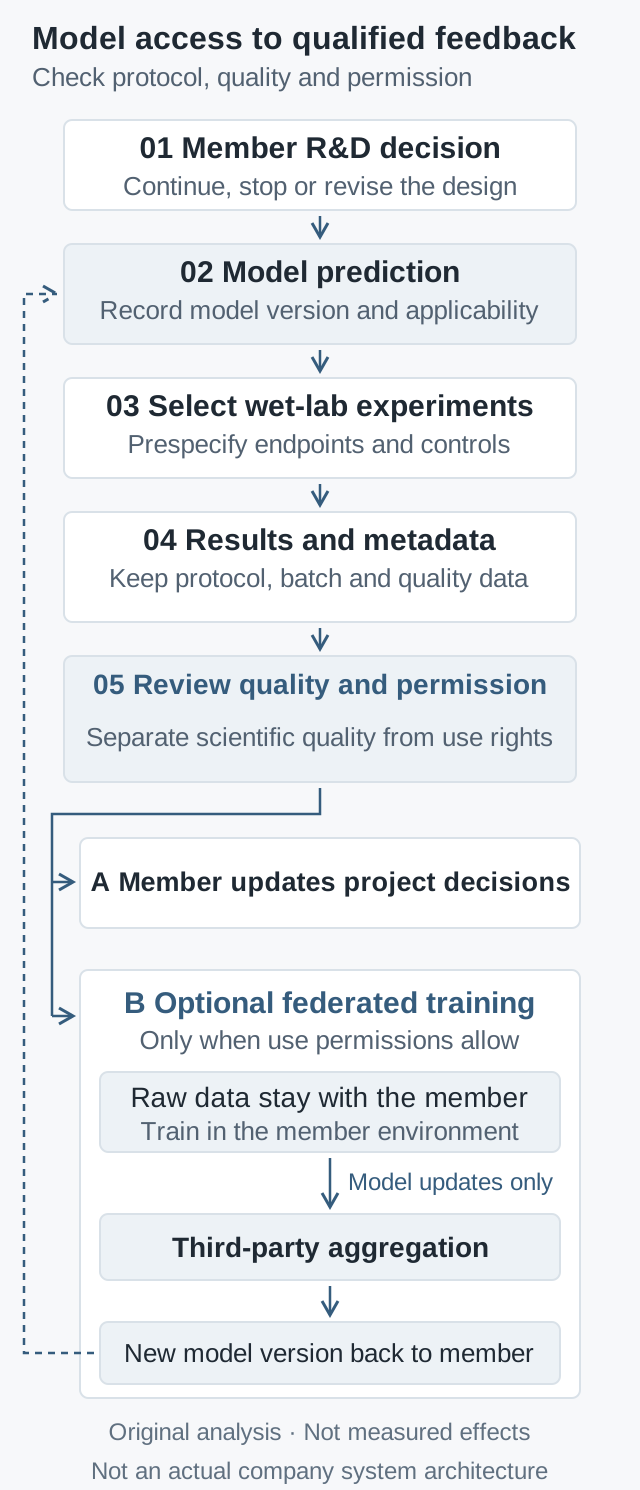
The interface matters because predictions do not create labels. A score suggesting that an antibody sequence may aggregate becomes comparable to a measurement only with experimental conditions, sample preparation, measurement methods, and quality controls. If models guide sequence selection and a laboratory supplies traceable results, members may reduce blind experimentation and, where permitted, contribute training information. The latter remains conditional; a service-provider connection does not establish it automatically.
The exchange therefore involves at least three resources: usable models, experimental information with context, and organizational coordination. Members still perform experiments, prepare data, judge applicability, and manage agreements. Even inexpensive model access need not make a valuable R&D decision inexpensive.
2. Local data still needs a shared scientific language
The current TuneLab FAQ describes federated training in which a model is sent to participating companies' nodes, trained locally, and returned as model updates for aggregation by a third-party-hosted service. Underlying molecular structures, sequences, and individual records are not directly uploaded with those updates. The FAQ also describes reviewing aggregate statistics, assay conditions, and protocols for quality. This is the platform's public account of its design, not an independent security audit of every deployment by this article.
“Raw data stays local” and “governance is unnecessary” are different propositions. Suppose two laboratories both supply a label called solubility but use different pH conditions, time windows, or detection limits. A model may learn laboratory offsets rather than molecular relationships that transfer across projects. Turning inconsistent data into parameter updates does not automatically remove the inconsistency.
A useful feedback interface should align endpoint definitions, units, detection limits, batches, failed-experiment and missing-value codes, and permitted model uses. These are analytical recommendations, not claims that TuneLab has publicly demonstrated every measure. Chemical scaffolds or sequence families outside a model's training scope also require independent evaluation; an uncertainty score alone is not a guarantee of reliability.
In CDD's written webinar account published on October 1, 2026, TuneLab's leader described versioned model cards covering training data, protocols, architecture, and metrics, as well as efforts to build independent test sets in new chemical space. That supports the view that interpretable and testable data interfaces are becoming part of the product. It does not establish that better generalization has already been achieved. This article uses the organizer's written account, not an independent experimental report.
Original analytical diagram, not outcome data or a company's disclosed complete system architecture. The dashed feedback path depends on quality, permission, and model applicability; it does not imply automatic platform ownership of every result or intellectual-property right.
3. An experiment creates business value by improving the next decision
Treating “more experiments” as value can also mislead. Some experiments repeat what a team already believes; a negative result may instead stop an expensive direction early. A customer should ask how an experiment changes a decision to continue, stop, or redesign, rather than simply how many data points it produces.
A general value-of-information framework makes the distinction explicit. Let \(\mathcal D\) be existing evidence, \(\theta\) the uncertain project state, and \(a\in\mathcal A\) an available action. Let \(U(a,\theta)\) be project net value on a common time and monetary basis, including downstream benefits and costs of the action. The value of the current optimal decision is:
For an additional experiment \(e\) with an unobserved outcome \(y\), combine experimentation, data preparation, agreement coordination, and waiting costs not already counted in project value into \(C(e)\). Its net expected information value can be written as:
This is an analytical lens, not a valuation of Lilly, GenScript, or any drug program. All monetary quantities use the same valuation date. A cost cannot be deducted in both \(U\) and \(C\); sunk costs of existing data are not incremental spending on the new experiment. Expectations include every possible outcome, not just the successful branch. Application requires credible probability and value estimates, which cannot be obtained from a model leaderboard.
Under ideal conditions of unchanged available actions, the option to ignore information, and a coherent probability model, information cannot reduce optimal expected decision value before its cost. Yet its value may be negligible, and its net value negative. If a result changes a score's decimal places but not resource allocation, a customer may not keep investing. If a credible negative result prevents a mistaken expansion, stopping a program can be a useful product outcome. Short-term advancement rates alone therefore cannot define platform quality.
The framework also explains the business significance of data quality. Wrong units, selective reporting, or irreproducible experiments can distort updated beliefs. A system may then make bad decisions with greater confidence, and the ideal information-value result no longer justifies its use. This article runs no drug-development experiment and estimates no actual information value for the companies discussed.
4. Who might capture value, and who still bears costs?
The following is business analysis derived from public product mechanisms, not a statement of confirmed company revenue structures. For a large pharmaceutical company, broader model use may create opportunities to learn from different experimental conditions and molecular spaces. Learning benefits require both appropriate permissions and feedback that improves its own or ecosystem models. Acquiring model users does not automatically confer rights to their drug assets, purchase preferences, or all downstream data.
For an experimental-service provider, the opportunity is more direct: turn model-proposed candidates into executable laboratory orders. If GenScript's standardized documentation reduces rework and time to acceptable data, it may compete on more than cheap experiments. Preferred rates can also reduce revenue per order; incremental demand, capacity utilization, rework costs, and margins need separate observation. Appearing on a partner list does not demonstrate those improvements.
A data-management vendor can reduce the work of moving predictions and measurements between tools. CDD's October 1 account describes model integration into an environment scientists already use to manage research data. My inference is that this could reduce switching between tools and losing metadata, while strengthening existing software use. Whether it creates upselling, renewal, or simply a more convenient existing feature requires commercial evidence.
A smaller biotech may benefit by accessing established models with less internal development effort and directing a limited wet-lab budget toward experiments that most affect its next decision. The costs include contributing suitable data, maintaining its local environment, and managing out-of-domain model risk. If a platform mainly helps teams that already possess substantial clean datasets, it could widen capability gaps rather than automatically lower every participation barrier.
Value allocation depends on two capabilities working together: models must make useful predictions, and organizations must connect new evidence to decisions and training. Open formats, portable records, and use of multiple platforms weaken exclusivity. Hard-to-reproduce experimental quality, stable endpoint definitions, and credible permissions could instead provide an advantage. None of this is equivalent to saying that more data must make a platform stronger.
5. Separate partnership growth, scientific acceptance, and drug success
A useful comparison comes from outside TuneLab. Recursion's August 5, 2026 earnings release filed with the SEC states that Genentech exercised the first Validated Target Option in their neuroscience collaboration, advancing a target into an early small-molecule discovery program. It describes sequential pathway, functional, and disease validation. The next steps still include small-molecule design, hit generation, and validation.
This is a concrete example of a partner accepting stage-specific evidence and advancing work. It is not a TuneLab result, proof of clinical benefit, or final drug sales, and it does not provide a complete candidate denominator sufficient to estimate overall platform success rates. Upfront payments, milestone payments, current accounting revenue, and drug revenue are different measures. A potential contractual maximum is not realized commercial scale.
For a network such as TuneLab, a similar evidence hierarchy offers an observation framework: integration works; data can be used under explicit rules; new versions add value on independent projects; programs pass prespecified scientific gates; and members remain willing to commit resources. This is a path to test, not a claim that the company already has particular acceptance clauses.
Supplier participation and member availability must also be distinguished. GenScript's participation does not establish that the platform is generally open to every mainland Chinese biotech. The public service terms accessed for this article list supported territories, and the current list does not include mainland China. Access, permitted data uses, and intellectual-property arrangements depend on applicable agreements. News releases cannot establish the complete allocation of rights; this article did not obtain contracts behind the member login.
6. What would overturn the business thesis?
The first alternative is a channel partnership. Experimental discounts and software integration may primarily acquire customers, who then run their usual experiments and generate little reusable training feedback. If registration, model calls, and partner counts grow without independent validation or sustained contributions, the “learning network” thesis should narrow to a “distribution network” thesis. Distribution can have commercial value, but for a different reason.
A second explanation is quality selection. Stronger members already have better data and teams and might progress faster without the platform. Comparing members with nonmembers would then confuse selection with platform benefit. A more credible design freezes candidate pools, experimental budgets, model versions, and acceptance rules within a team, comparing the existing approach with platform assistance prospectively. Prespecify randomized workflow assignment across comparable projects or experimental batches, and where feasible blind assay and acceptance assessors to the workflow that produced each candidate, reducing time, batch, and assessment biases. Where randomization is infeasible, report these remaining confounders. Report by project or experimental batch and retain failures and invalid measurements. This is a proposed design, not an experiment performed here.
A third boundary is local benefit without transfer. New data may only improve the contributor's familiar chemical series, providing no gain on new scaffolds, laboratories, or antibody families, or even causing regression through inconsistent labels. The platform could remain a useful customized tool without broad cross-member network effects. Expensive protocol standardization may also consume the gains from models.
Finally, if general models, open data, or cheaper specialized baselines achieve the same results under equal experimental budgets, a complex collaboration mechanism may not be worthwhile. If members can switch platforms while retaining data, protocols, and decision records, a single platform's bargaining power may also be limited. The evidence required is sustained incremental value, not a complete-looking interface or a conceptual feedback loop.
7. What to observe over the next 6–24 months
These windows begin on this article's publication date; they are not company forecasts. When an indicator is not publicly available, leave it unknown rather than substitute membership or cumulative inference counts.
Window
Priority evidence
Question tested
Within 6 months, by April 2027
Time to acceptable data, metadata completeness, rework, and data actually entering training under applicable permissions
Do experimental and governance interfaces function?
6–12 months, by October 2027
Version comparisons on frozen tests, with separate new-chemical-space, new-laboratory, and failure results; prospective decision comparisons under equal wet-lab budgets
Does additional feedback create transferable incremental value?
12–24 months, by October 2028
Sustained member use and contributions, laboratory-service repeat purchases and margins, independent project gates, and deliberately stopped programs with reasons
Does customer value sustain commercial relationships beyond subsidized trials?
These windows may be too short to establish clinical success, so approved-drug counts should not be the only criterion for every short-term project. A more actionable question is whether the platform can help members learn earlier, at an acceptable total cost, what to continue, what to stop, and what to measure next. If it can do so repeatedly, model access may grow into a useful research network. If it only sends more predictions into laboratory queues faster, costs may grow faster as well.