两者共同提供了一个值得检验的方向:AI 供应商开始把“模型之外的运行条件”放到产品叙事的中心。但对商业分析,叙事只是起点。关键证据应继续下沉到具体服务的地域、功能、版本、报价和交付责任。下面用阿里 Model Studio 的配置说明与 Claude 的地域计价规则,拆解这种产品维度。
需要保留一个状态校正:Foundry Local on Azure Local 的官方概览在 2026 年 9 月 14 日更新的版本仍标明预览,并将企业集群上的产品与终端设备上的 Foundry Local 区分。不能把后一条路径的可用状态,自动转移到前者;也不能从本地部署方案推断所有云端闭源模型都能使用相同权重在客户机房运行。
3. 存储在哪里与推理在哪里,是两个问题
Model Studio 的 Regions and endpoints 文档更新于 2026 年 9 月 28 日。它把 region 定义为接入与静态数据存储位置,把 service deployment scope 定义为推理执行范围。例如 Frankfurt 可选择 Global 或 EU,Virginia 可选择 Global 或 US。因此,“请求打到法兰克福端点”本身不能推出“模型只在 EU 推理”。
Claude 官方计价文档给出直接证据:对 Claude 4.6 及后续支持模型,第一方 API 的 US-only inference 使用 \(1.1\) 倍标准 token 价格,覆盖输入、输出、缓存写入与缓存读取;Global 使用标准价格。这里讨论这条明确规则,不把它推广成所有厂商、所有地域或所有合同的统一加价。
Why Inference Geography Changes AI Pricing and Delivery
Use Alibaba region configurations, Claude US-only pricing, and Microsoft sovereign AI to separate storage, inference, and operations; examine procurement eligibility, capacity constraints, geographic premiums, and falsifiable 6–24-month indicators.
Why can the same model version, prompt, and output requirement command a different price—or lose necessary features—when inference geography is restricted? If an AI service is just a model name and a price per million tokens, the difference can look like a channel markup. The buyer also purchases where that model may execute and whether the complete business process can operate within that boundary.
My thesis is that geographic and operational controls are becoming dimensions of AI products, but a geographic label alone does not establish a durable business advantage. Storage, inference, and feature boundaries determine whether a configuration enters a customer's eligible procurement set. Delivery, performance, and price are compared afterward. A narrower inference scope can change resource access and delivery conditions; it does not identify the magnitude of actual cost or prove profit from a published premium.
The discussion uses official announcements and product documentation actually read as of October 8, 2026. No paid API calls, customer-console access, billing audit, or deployment-performance experiment was performed. The links from scheduling to willingness to pay and competition are analytical hypotheses, with acceptance criteria and ways to falsify them below.
1. A minimal baseline: establish eligibility before comparing prices
Fix a customer workload \(w\), such as processing internal company documents with specified output accuracy, required features, and service timing. The customer supplies permitted storage and inference scopes. This is an illustrative requirement, not a real customer project or a claim that any entire industry necessarily requires local deployment.
Let \(\mathcal D\) be the deployment configurations being compared. For configuration \(d\), \(S_d\) and \(P_d\) are the sets of possible storage and inference locations; \(S_w\) and \(P_w\) are the corresponding customer-permitted sets. \(V_w(d)=1\) denotes acceptance of the workload's required features, quality, operations, and failure handling. The eligible procurement set can be represented as:
This is analytical notation, not an automated compliance certificate. Location sets need a defined product scope and supporting evidence; an observed location for one call does not establish a restriction on all future calls. Retrieval, tools, logs, and other application dependencies belong in the relevant acceptance process, not only the final model generation.
This changes the ordering of price comparisons. If inference must remain within a defined scope, a cheap Global configuration without that assurance may be outside \(\mathcal D_w\). Its price difference from a restricted configuration is not necessarily money the customer can immediately save. Conversely, without that requirement or evidence of better service, a location label alone is no reason to assume the premium is worthwhile.
2. What do recent actions establish—and what remains open?
Alibaba Cloud's September 23, 2026 announcement plans its first regions in Türkiye, Finland, and the Netherlands over the following twelve months. This is a plan for local delivery, not evidence that all model services are already open there. Microsoft's October 5 Sovereign AI article presents a white-paper framework around control, choice, flexibility, and resilience, selecting operating models by workload. It is not an announcement that the entire portfolio became newly generally available that day.
These actions suggest a testable direction: AI suppliers are placing operating conditions beyond the model at the center of their product story. For business analysis, that story is only a starting point. Evidence must descend to the specific service's geography, features, versions, price, and delivery responsibilities. Model Studio's configuration documentation and Claude's geographic pricing make the product dimension more concrete.
Keep an availability correction explicit. The official Foundry Local on Azure Local overview, updated September 14, 2026, still identifies preview status and distinguishes the enterprise-cluster product from Foundry Local on end-user devices. Availability for the latter cannot simply transfer to the former. A local-deployment option also does not establish that every cloud-hosted proprietary model can run with identical weights in the customer's data center.
3. Storage location and inference location are separate questions
Model Studio's Regions and endpoints documentation was updated September 28, 2026. It defines region as the entry point and location for data at rest, while service deployment scope determines inference execution. Frankfurt, for example, offers Global or EU scopes, and Virginia Global or US. A request arriving at a Frankfurt endpoint does not by itself establish EU-only model inference.
The same page says that endpoints, API keys, and model lists cannot be reused across regions. Its feature matrix supports batch inference and fine-tuning in Beijing and Singapore, but not the other four listed regions. That already demonstrates that geography changes more than a URL. Singapore's scope is International, not Singapore-only inference. Model entitlements and quotas for an actual account require separate confirmation.
Claude's geographic-control documentation likewise separates inference geo from workspace geo: the former controls model inference, while the latter controls storage at rest and some endpoint processing. At reading, inference could be US or Global; workspace geo provided only US. The controls are not interchangeable. A model request's inference scope also does not automatically locate third-party retrieval, external tools, or customer-maintained application logs within that scope.
The separation is technically sensible: entry services handle authentication and requests, inference nodes execute the model, and persistent data and tools may use other services. Commercially, procurement changes from buying a named model to buying that model in a particular deliverable configuration. A demonstration that generates the right answer has not established that the configuration meets input, dependency, and recovery requirements.
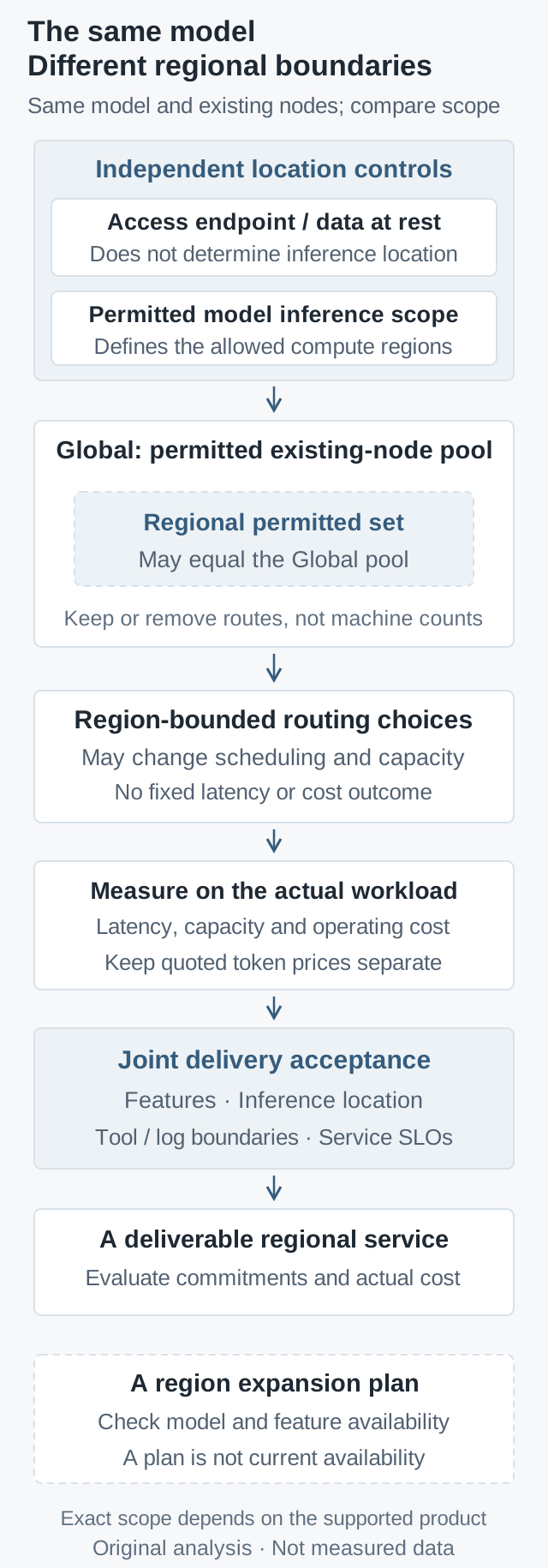
Original analysis: entry and data-at-rest location do not substitute for an inference-region control. Holding the model and existing nodes fixed, a regional constraint can retain or remove original permitted routes; the two sets may coincide. Routing constraints may affect scheduling and capacity, while actual latency and cost still require workload-specific measurement. Features, inference location, tool and log boundaries, and service performance jointly determine deliverability. Sets do not encode machine counts, and expansion plans do not establish current model or feature availability.
4. How does geography enter scheduling and capacity?
Start with a weak but checkable inference. Holding the model and existing inference-node set fixed, adding geographic restrictions can retain previously allowed routing nodes or remove some of them. Conceptually:
This set relation is not a throughput curve. Global routing can seek idle capacity in different locations; restricted routing relinquishes choices outside its scope. If demand peaks concentrate within the restricted area, the same service objective may require more local headroom, different capacity commitments, or waiting policies. If the supplier adds dedicated capacity along with the restriction, separate the added resources from the restriction itself.
A smaller set does not imply worse latency. Proximity to data and users can reduce network round trips, fixed routing may improve cache reuse, and regional capacity may be less congested. Latency also includes queuing, prompt processing, token-by-token generation, and tool waits. Long inputs and long outputs consume different time and resources; an average response time can conceal peak-load tails and rejected requests.
Nor does a larger pool guarantee a cheaper service for every customer. Cross-region transfer, cold caches, hardware mix, and utilization affect costs. The conditional explanation is that geographic restrictions can remove some freedom to share resources and schedule work, making an assured delivery boundary a distinct product attribute. Establishing its cost requires matched model versions, input/output distributions, loads, and acceptance targets. Establishing profit additionally requires realized supplier costs and transaction information.
5. A verifiable premium establishes pricing, not production cost
Claude's official pricing documentation provides direct evidence: for supported Claude 4.6 and later models, US-only inference on the first-party API uses \(1.1\) times standard token rates, including input, output, cache writes, and cache reads. Global uses standard pricing. This is one explicit rule, not a universal premium across vendors, geographies, or negotiated contracts.
Hold usage and applicable rates fixed. Let \(\mathcal K\) denote those token-billing categories, \(T_k\) the token count in category \(k\), and \(p_k\) its dollar rate per million tokens, with other applicable pricing conditions unchanged. The token-bill arithmetic is:
This is neither a measured invoice nor a total-application-cost equation. Changed cache hits, retries, tool and runtime charges, networking, and labor are excluded. Discounts and contract terms need separate checking. If routing changes actual usage, the equal-\(T_k\) assumption no longer supports a claim that total spend changes by only ten percent.
Capacity accounting is separate. The Priority Tier note in the residency documentation also counts US-only tokens at \(1.1\) times against committed TPM. This is a rule for drawing down committed capacity, not a measurement of ten-percent slower computation or an automatic increase in general rate limits. Buyers need both the price and capacity-accounting rules for an otherwise matched commitment.
Why price this way? At least three explanations remain: supplying a restricted resource pool costs more; customers value an additional delivery assurance; or the supplier differentiates products by demand elasticity. Public documentation establishes the premium, not the relative contribution of each explanation. Inferring either a ten-percent cost increase or excess profit directly from a ten-percent premium skips evidence that is not disclosed.
6. A concrete procurement question: can the document-processing chain run?
Return to the illustrative enterprise-document task. Fix sample documents, accepted error types, arrival load, required features, and storage/inference scopes. The baseline can be the existing human process or an already permitted service, but comparisons must concern the same business result. An ineligible location cannot be excused by a better model score. A location-eligible service missing a necessary batch feature likewise cannot be compared solely on token prices.
The following is a proposed acceptance method, not an executed test. Start with non-sensitive test material to validate the configuration, then enter an actual project through customer-approved procedures. Each step serves a distinct purpose, and failure at any step can prevent delivery.
Stage
What to inspect
Why it affects delivery
Configuration and location
Exact model version, endpoint, allowed scopes, defaults, and overrides; documentation, contracts, and available request records
Do not mistake an entry region for inference assurance; one record does not constrain every future call
Dependencies and features
Actual scope and availability of retrieval, tools, logs, identity, batch jobs, and recovery
A working generation API can still leave the complete process dependent on crossing a boundary or stopping
Load and outcomes
Latency distributions, concurrency, rejection, retries, and recoverable results after failure at a shared quality target
Validate peak-load service instead of substituting a lightly loaded demonstration
Bills and responsibilities
Category usage, capacity drawdown, other charges, and responsibility for upgrades, incidents, and evidence records
Map published rates to actual procurement and continuing operational responsibility
If offline operation is also required, the problem changes further. Microsoft's disconnected-deployment documentation describes obtaining extensions and models from pre-imported packages and local registries, using local Active Directory dependencies, and collecting diagnostics locally. This still-preview path illustrates that disconnected operation requires reconstructing dependencies in advance; merely cutting connectivity to a cloud API cannot preserve the service.
Offline procurement therefore includes operating capability as well as model execution. Updating models, certificates, capacity, and recovery entails continuing work that one deployment acceptance cannot exhaust. This is architectural reasoning, not a demonstrated change in customer cost. Local deployment can suit particular cases without becoming a universally better substitute for regional services.
7. Who might capture value—and why a premium might disappear
If a delivery boundary brings an otherwise ineligible workload into \(\mathcal D_w\), willingness to pay may come from newly executable business, rather than a slightly better answer. A platform already integrated with the customer's identity, network, logging, and operations may find it easier to incorporate a model into an accepted service. Regional operators and integrators may capture value through local operation, dependency integration, and support. Model providers may sell versions and services with specified inference assurances.
These are value-chain hypotheses, not amounts that can be added up as realized revenue. End customers must adopt and renew; channels need contribution after delivery cost; fee allocation between model and cloud suppliers depends on contracts. Region construction first creates delivery options and resource commitments, not necessarily local paid demand.
Keep alternative explanations alive. Reducing the need to send sensitive material externally, or using another sufficiently capable model for the same outcome, can shrink the market for a geographic premium. If several suppliers satisfy a boundary through portable evidence and interfaces, the control becomes a procurement prerequisite without necessarily becoming an exclusive long-term advantage. Low local utilization, model-version lag, or expensive support can prevent the added market from compensating for delivery costs.
Customers may also allocate different tasks to different configurations: permitted general work to broader routing, specific work to restricted routing. Coexistence depends on the relevant permissions and defaults. Geography need not produce disconnected market islands or eliminate globally shared capacity. Competition may concern which configurations can be delivered with consistent evidence, operations, and upgrades, rather than the number of points on a map.
8. How could the next 6–24 months falsify the thesis?
The proposed trend is that verifiable operating boundaries will keep shaping AI product selection and may let suppliers compete for newly eligible workloads. It predicts neither a company's share price nor a fixed market share or margin. The windows below are an observation plan, not reported outcomes.
Window
What to observe
Evidence weakening or falsifying the thesis
6 months: through April 2027
Which construction and preview plans become available configurations; verifiable models, features, scopes, and upgrade versions
Additional region names without necessary models/features; unverifiable boundaries that do not expand the eligible set
12 months: through October 2027
Time to production, service outcomes, and full recurring expenses under equivalent requirements; separately count pilot-to-paid conversion
Other configurations meet the same requirements with less burden; new scenarios do not convert to paid use, or delivery burdens exceed value
24 months: through October 2028
Renewals, version gaps, realized contribution, and retained customer alternatives in mature deployments
Standardized controls/evidence make substitution easy; idle capacity or persistent version lag prevents a retained premium
Follow a separable chain when judging the direction: public plans, specific available configurations, customer acceptance, payment, and continuing contribution. Earlier links cannot establish later ones. Regional inference matters because it turns an architectural permitted scope into a product choice. Its business value still depends on whether the work placed within that scope can operate sustainably.