How Does Open Compute Software Change Bargaining Power in AI Hardware?
DeepSeek’s Ascend tools, NVIDIA Dynamo, and AMD software optimization reveal how interface reuse can change fixed migration costs—and what makes alternative compute an executable procurement option.
On September 30, 2026, DeepSeek's DeepGEMM-Ascend released support for Ascend 950, TileKernels added an Ascend backend, and the main TileLang repository announced a native Ascend 950 backend. These releases make another software path for accelerator migration inspectable. The commercial question is whether that path makes alternative compute a supplier option customers can actually switch to, affecting price, delivery, and support terms.
My assessment is that reusable interfaces and public source can first reduce the fixed cost of evaluating a migration. Bargaining power becomes plausible only after the alternative repeatedly passes quality, service-performance, and operational acceptance on customer workloads. This analysis uses original repositories and vendor documents read as of October 8, 2026, with repository citations pinned to commits. The cost model and market implications below are analysis, not measured migration savings or market-share forecasts.
1. Which work does interface reuse remove?
DeepGEMM-Ascend's README states compatibility with DeepGEMM APIs, covering operators including BF16, FP8, and FP4 GEMM. TileKernels uses the same Python APIs to select a backend automatically for its covered operators. Existing teams may thereby reduce call-site rewriting, interface learning, and duplicated test development. These benefits apply to particular libraries and operators; they do not establish that complete CUDA applications run unchanged.
Hardware-specific details remain. DeepGEMM-Ascend documents scaling-factor packing and storage layouts that differ from the NVIDIA path. The TileLang Ascend guide retains choices about device dialects, buffers, layouts, and compute tiles. Matching API names can reuse higher-level intent while the implementation still organizes computation around the hardware. Compatibility of quantized data, cache metadata, and custom operators must be checked along the actual call chain.
The September 30 change also has a specific scope: native Ascend 950 support in the main TileLang repository. Older Ascend generations already had external ecosystem adapters. Describing this as the first support for Ascend would merge native integration with an earlier adaptation history. Procurement needs a maintained combination of hardware, compiler, and operators, and evidence that updates preserve its acceptance results.
2. The communication library exposes a longer delivery chain
As read for this article, DeepEP-Ascend provides MoE dispatch/combine communication and aligns its public buffer APIs with the NVIDIA version. MoE routes tokens to selected experts and combines their computed outputs. Interconnect communication, expert balance, and overlap with matrix computation therefore affect usable capacity. Theoretical compute per device omits time spent waiting for data or other experts.
The original README carefully bounds its bandwidth results. Measurements use Ascend 950DT, CANN 9.2.0, and a manually configured PoC HDK supplied specifically to DeepSeek; that configuration is not a public release. Public availability of the recommended Q3 commercial HDK remains planned for mid-October 2026, around October 15, subject to Huawei's actual publication. Timings also exclude final epilogues. The measurements therefore do not establish a commercial stack already reproducible by ordinary customers, or complete-model request latency.
The delivery chain includes public code, obtainable drivers and firmware, matching compilers and frameworks, the actual interconnect, and maintained feature coverage. Source access makes problems inspectable but does not replace availability of dependencies. Licenses also need component-level checking; one library's permission cannot be assumed for the entire combination.
Customers need an environment they can install, keep updated, diagnose, and recover. Components need not share a license or supplier. Their responsibilities and availability conditions do need to be clear enough to enter deployment plans and cost estimates.
3. Three acceptance layers remain between an operator and a service
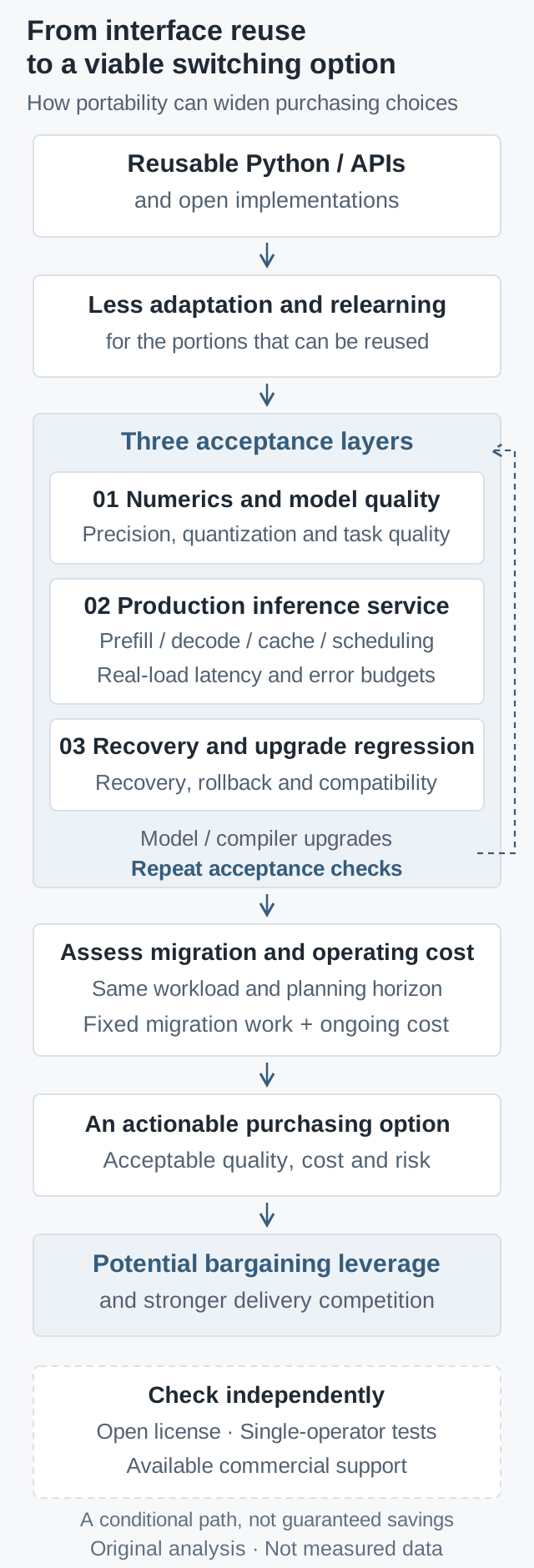
The first is numerical and model quality. Identical checkpoints do not guarantee identical task quality under different quantization, scaling layouts, and kernels simply because interfaces match. Check operator errors and unusual shapes, then target-task metrics, long contexts, tool-call formats, and failures. Fix quality thresholds before comparing capacity to prevent relaxed quality from masquerading as higher throughput.
The second is performance under real traffic. Prefill processes input prefixes; decode generates outputs incrementally. Their computation, weight access, and KV-cache behavior differ, with bottlenecks depending on batch size, model, context length, and parallelism. Time to first token (TTFT) also includes overhead such as queueing and cannot be equated with pure prefill time. Generation experience additionally depends on token intervals, long-tail requests, and interruptions.
A proposed comparison should replay the same arrivals, input/output length distribution, warm/cold cache conditions, and model-quality requirements, then measure qualified capacity at identical service targets. Test both steady traffic and bursts near saturation, reporting tail latency, rejection, and timeout rates. A configuration with greater aggregate token throughput but frequent missed interactive targets might fit an offline workload while failing the current product.
The third is sustained delivery: what happens to in-flight generation after node failure, whether upgrades break cache and communication interfaces, how many operators a new model needs, and whether rollback works. Rapid model and compiler changes can turn today's successful migration into another maintenance branch. Record upgrade engineering hours and regression failures to distinguish reusable capability from continuing overhead. No hardware or traffic experiments were executed for this article; these are proposed acceptance methods.
Original analytical framework, not measured data. Arrows are conditional mechanisms. Source openness, dependency availability, and service acceptance require separate checks; none alone demonstrates customer profit.
4. When can migration pay back? Specify fixed costs first
Consider a restricted planning case. The incumbent platform \(N\) and candidate \(A\) already meet identical quality and service requirements. Compare future costs over a fixed horizon, at the same standardized work volume \(Q\), within a capacity range where a linear approximation is reasonable:
\(M\) is the incremental one-time cost of migration evaluation, validation, cutover, and necessary parallel operation. \(F_N,F_A\) contain other fixed costs over that horizon, including capacity commitments and continuing maintenance under a consistent accounting method. \(c_N,c_A\) are incremental operating costs per standardized work unit. Currency and the units of \(Q\) must match. Irrecoverable historical spending on the incumbent should not be counted again as a cost avoidable through this migration. Failures, retries, and idle-resource expense belong in the appropriate cost components, rather than counting only finally returned tokens. If incumbent capacity commitments remain unavoidable after switching, retain their future costs in the candidate plan’s \(F_A\); ceasing to use the incumbent does not make the expense disappear.
This is not a forecast of accelerator prices. It explains a direction: interface reuse that reduces \(M\), with other conditions unchanged, lowers the volume needed to amortize migration. Continuing maintenance that raises \(F_A\), or the absence of lower \(c_A\) under real traffic, can reverse the result. Without the two stated conditions, the positive threshold cannot be copied. In particular, a positive fixed-cost difference and no lower candidate unit cost mean more volume cannot produce payback in this model.
Real procurement is often discrete, segmented, and utilization-dependent. Another cluster's fixed investment, changing cache hits, and burst capacity can change unit costs. Estimate capacity and cost for each feasible configuration instead of inserting peak throughput and a device quote into a permanently fixed slope. If \(Q^\star\) lies outside that configuration’s feasible capacity or linear range, this threshold cannot be applied directly either. For volatile demand, an evaluation may create an option: establish whether switching is feasible before committing workload. That option also depends on supply, support, and actual switching lead time.
5. How can an open ecosystem change value allocation?
NVIDIA's Dynamo overview describes an open distributed inference platform that connects engines including vLLM, SGLang, and TensorRT-LLM and supports NVIDIA and AMD GPUs and Intel XPUs. Open service layers and cross-hardware support are already part of competition. Shared interfaces can help customers reuse serving components while individual hardware paths retain distinct optimization and support coverage.
Dynamo v1.5.0, released on September 18, 2026, continues to change routing, KV indexing, and deployment components, alongside compatibility and deprecation information. My inference is that continuing software investment can increase usable hardware output and give suppliers a role in customers' performance and operating standards. Open software may reduce switching barriers while increasing demand for complementary hardware, networks, and delivery capabilities. It does not automatically transfer profit away from incumbents.
AMD's September 16, 2026 MLPerf Inference 6.1 discussion similarly attributes improvements across rounds on the same MI355X generation to ROCm and open inference-stack optimization. This is a vendor report of standardized benchmark results, illustrating the possibility of software improving hardware utilization. It neither isolates an individual component's causal contribution nor proves a customer's migration has paid back. Under the MLPerf rules, Closed division has quality thresholds, and Server/Interactive add their respective latency constraints. Offline measures throughput without per-request latency thresholds, while Open division permits relaxed constraints with actual conditions reported. Check the division and scenario before validating customer traffic, obtainable configurations, reliability, and full costs.
For Huawei and DeepSeek, aligned interfaces could turn optimization experience with known models into adaptation paths other teams can inspect and maintain. Reducing duplicated engineering when adopting different hardware could expand the workloads they can serve. For NVIDIA and AMD, competition also continues through speed of new-model support, qualified capacity, diagnosability, and the engineering burden of platform updates.
Cloud providers and service operators may gain configuration choices and amortize migration and acceptance across customers. Supporting multiple hardware branches also adds cost; scale benefits are limited if each customer requires a fresh tuning project. Customer options, supplier revenue, and supplier profit are separate evidence. A code release, benchmark submission, or partnership statement does not by itself demonstrate improvement in all three.
6. Three alternative explanations constrain the thesis
One explanation is that platform selection primarily reflects supply availability, deployment requirements, or procurement policy. Adoption can occur without a large reduction in technical migration costs. That may explain installation counts but does not independently establish better unit economics from open software. Test the thesis by examining projects with similar constraints for lower deployment effort and continuing maintenance burdens.
A second explanation is deep co-optimization of a particular model and chip, rather than broad portability. Efficient communication for one MoE layout may not cover another model, quantization format, or multimodal workload. If model upgrades require extensive rewrites, the software can remain valuable, but the claim should concern delivery of a particular combination rather than general migration capability.
A third case is demand that is too small or changes too quickly to amortize fixed costs. Incumbents can also respond with lower prices, faster support, or better utilization, erasing a previously estimated cost advantage. An executable switching option can therefore improve terms without increasing actual switched volume. Customers might benefit from the option while the alternative hardware supplier gains no proportionate revenue. Record quotations, adoption, and operating outcomes together.
7. What would be informative over the next 6–24 months?
These windows run from October 8, 2026 and define an observation protocol. First check whether recommended software and firmware actually become obtainable as planned, then examine maintainable external deployments. No growth multipliers are assumed.
Window
Observable measures
Claim tested
Within 6 months By April 2027
Complete version combinations obtainable by external teams; engineering hours from installation to passing identical workload acceptance; qualified capacity, tail latency, timeouts, and recovery
Do public interfaces reduce real deployment labor? Are results reproducible with an obtainable stack?
6–12 months By October 2027
Regression effort and failures across consecutive model/compiler upgrades; newly supported workloads; full cost differences at fixed work volume and horizon
Is migration sustainable? Does one optimization become reusable capability or another maintenance branch?
12–24 months By October 2028
Executable switching share, procurement terms, and paid continued use among accepted projects; service margins including multi-platform engineering and support
Do technical options yield bargaining power and repeatable delivery? Does value accrue to customers, chip suppliers, or operators?
If open adaptations proliferate without reducing independent projects' deployment and upgrade burdens, narrow the claim that they lower fixed migration costs. If qualified capacity improves without better full costs or procurement terms, technical progress cannot directly be called a customer economic gain. If only one carefully tuned model combination works, test continuing demand for that combination rather than claiming market-wide replacement.
The trend to watch is whether customers retain executable compute choices while models evolve rapidly. Open interfaces make this more plausible. Stable delivery and clear cost accounting determine when it becomes a commercial reality.